

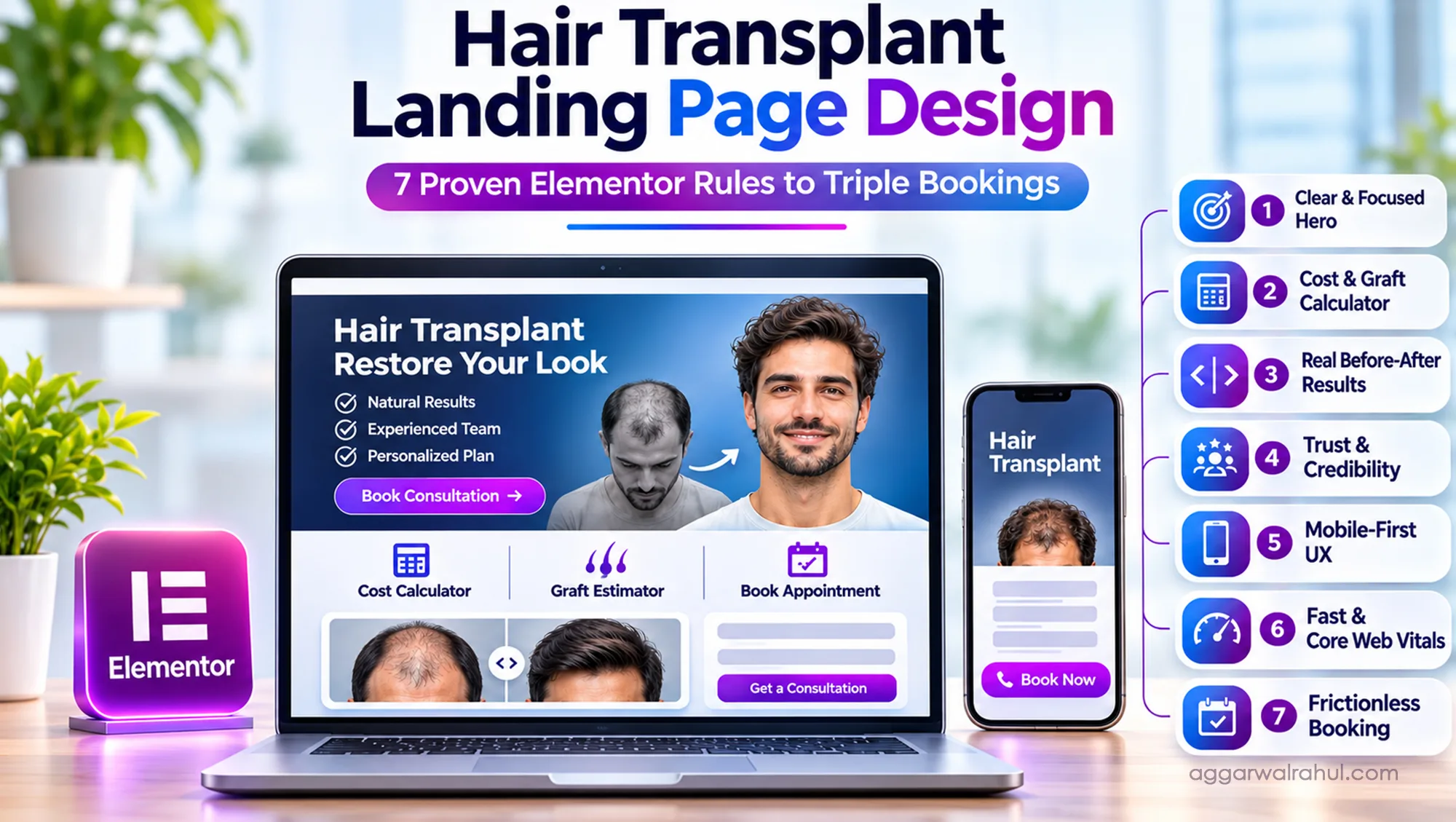
Hair Transplant Landing Page Design: 7 Proven Elementor Rules to Triple Bookings
Strategic hair transplant landing page design focuses on conversion-centered architecture rather than visual aesthetics. High-performing pages replace static contact forms with interactive diagnostic widgets, establish immediate surgical authority through verified medical credentials, and utilize high-resolution macro before-and-after sliders. Built on lightweight Elementor containers to achieve sub-1.2-second mobile load times, this structured landing page framework routinely increases qualified surgical consultation requests by 35% to 52% while reducing customer acquisition costs for competitive Google Ads and paid social campaigns.
A high-performing hair transplant landing page design is the single most critical asset in an aesthetic clinic’s digital marketing ecosystem.
When a prospective patient clicks on an advertisement for hair restoration surgery, they are preparing to make a life-altering, high-ticket investment ranging from $4,000 to $15,000. They are not looking for an online brochure filled with stock photography of smiling models. They are seeking clinical proof, procedural clarity, transparent pricing, and reassuring medical authority.
Yet the vast majority of clinics drive high-cost Google Ads and Meta traffic directly to an unfocused homepage or a sluggish service page. Visitors are met with crowded navigation bars, vague promises, and a generic contact form that demands personal contact information before providing any value.
The result? Over 60% of paid mobile traffic bounces within eight seconds, burning your patient acquisition budget.
Executing a high-converting hair transplant landing page design using WordPress and Elementor requires a systematic approach to user experience. Over 8+ years of engineering web platforms for global clinics, I have distilled the difference between failing pages and multi-million-dollar booking engines down to seven foundational rules.
Table of Contents
- Why Standard Aesthetic Web Pages Fail
- Rule 1: The Trust-Anchored Hero Container
- Rule 2: Interactive Self-Diagnosis Over Passive Forms
- Rule 3: High-Resolution Follicle Proof and Dynamic Case Studies
- Rule 4: Surgeon Credentials, Board Certifications, and ISHRS Accreditations
- Rule 5: Transparent Surgical Pricing and Procedure Packaging
- Rule 6: Sticky Mobile Booking Triggers and Asynchronous Lead Intake
- Rule 7: Core Web Vitals and Lightweight Container Architecture
- Frequently Asked Questions
- Transform Your Clinic’s Inbound Conversion Engine
Why Standard Aesthetic Web Pages Fail
Standard medical websites fail because they ignore the acute psychological vulnerability of elective surgery patients.
According to practice census reports from the International Society of Hair Restoration Surgery (ISHRS), over 80% of surgical patients actively research technical methodologies—such as Sapphire Follicular Unit Extraction (FUE) versus Direct Hair Implantation (DHI)—months before booking their first clinical consultation. Furthermore, clinical studies archived on PubMed Central demonstrate that patient satisfaction and procedural confidence directly correlate with clear pre-operative expectations regarding density and graft requirements.
When your hair transplant landing page design relies on ambiguous marketing slogans like “World-Class Hair Restoration,” you trigger immediate skepticism:
- Navigational Distraction: Standard websites offer 10 to 15 navigation links in the header, encouraging paid ad visitors to wander into irrelevant blog archives and leave without converting.
- Lack of Contextual Value: Forcing a patient to submit an email address simply to ask “How much does 2,500 grafts cost?” creates immediate friction.
- Bloated Mobile Performance: Stacking legacy page builders and unoptimized image carousels balloons page weights past 6MB, causing mobile visitors on cellular connections to abandon the page before the hero section even renders.
A dedicated landing page eliminates all peripheral noise. It provides a single, distraction-free conversion pathway engineered to move visitors from initial curiosity to a confirmed consultation.
Rule 1: The Trust-Anchored Hero Container
The hero section above the fold has a single objective: validate that the visitor has arrived at the premier destination for their specific hair loss problem within three seconds.
An effective hair transplant landing page design eliminates full-site navigation menus in the hero container. Remove the main site menu, search bars, and social media links. Keep only the clinic logo, a direct phone number, and a high-priority call-to-action button.
Your value proposition must combine clinical methodology with patient outcomes:
- Primary Headline: Focus on permanent, natural restoration. Example: “Precision Sapphire FUE & DHI Hair Restoration: High-Density Results Tailored to Your Natural Hairline.”
- Supporting Subheadline: Address primary patient objections upfront, such as doctor involvement, recovery speed, and natural follicle orientation. Example: “Doctor-led surgical planning, microscopic graft handling, and natural density protocols designed for lasting results.”
- Micro-Trust Badges: Immediately below the main headline, place three to four verification points: total successful procedures completed, average Google review score, surgeon board certifications, and sterile clinical facility accreditation.
Avoid generic stock imagery of laboratory beakers or models with untouched, perfect hairlines. Feature a high-definition, authentic macro photograph of a healed surgical hairline or a clean portrait of the primary operating surgeon.
Rule 2: Interactive Self-Diagnosis Over Passive Forms
Static contact forms demand complete commitment from a patient while providing zero value in return. In high-ticket elective surgery, asking an anonymous visitor to submit their private phone number without first answering their questions creates massive drop-off.
The centerpiece of a modern hair transplant landing page design is an interactive self-diagnostic tool.
By integrating a dynamic diagnostic system like the HairGraftPro WordPress Plugin, you provide immediate value:
- Gender & Pattern Classification: Visitors easily toggle between male (Norwood Scale Stages 2 through 6) and female (Ludwig Scale Types I through III) patterns.
- Technique Selection: Patients can compare techniques—such as Sapphire FUE, DHI Direct Hair, or Scalp Micro-Pigmentation (SMP)—and see how methodology impacts graft counts.
- Real-Time Estimation: The widget calculates estimated graft volumes and realistic cost ranges using the clinic’s native pricing structure.
- Real-Time AI Photo Scanning: Patients can take a live photo or upload an image directly from their phone. The integrated AI vision engine (utilizing Google Gemini or OpenAI GPT-4o-mini Vision) automatically evaluates thinning patterns and serves a structured assessment.
Once the patient views their customized estimate, the subsequent request to submit the profile to the surgical team feels like a logical clinical next step rather than a cold sales inquiry. You can test this exact workflow live on the HairGraftPro Live Demo.
Rule 3: High-Resolution Follicle Proof and Dynamic Case Studies
In aesthetic medicine, past results are your strongest sales asset. However, standard photo galleries with tiny, low-resolution thumbnails fail to convince prospective surgical patients.
Patients researching hair restoration want to scrutinize the work at the follicle level:
- Interactive Before-and-After Sliders: Replace static side-by-side images with interactive drag-to-reveal split comparison sliders.
- Follicle Zoom Loupe: Desktop visitors should be able to hover over the hairline with a 2.0x to 3.5x magnification loupe to verify natural single-hair graft placement along the transitional hairline zone, ensuring there is no artificial plug appearance.
- Standardized Clinical Badges: Every case study must include essential clinical metadata: exact graft count (e.g., 3,200 Grafts), technique utilized (Sapphire FUE), patient hair loss classification (Norwood Stage 4), and post-operative timeline (10 Months Post-Op).
- Taxonomy-Filtered Proof: Utilize custom post types to let visitors filter results by their specific hair loss pattern or hair texture (straight, wavy, curly, afro-textured). A prospective patient experiencing temple recession wants to see temple restoration results, not full-scalp mega-sessions.
When you present structured, verifiable data alongside macro imagery, you eliminate skepticism and build unassailable clinical credibility.
Rule 4: Surgeon Credentials, Board Certifications, and ISHRS Accreditations
With the proliferation of unlicensed and black-market hair restoration centers worldwide, patient fear regarding technician-led clinics is at an all-time high.
Your hair transplant landing page design must actively address patient safety and surgical ethics.
Dedicate a prominent container directly following your social proof to your medical leadership:
- Doctor Identity & Experience: Prominently showcase the operating surgeon’s face, full medical credentials, university background, and years of dedicated experience in surgical hair restoration.
- Explicit Physician Involvement: Clearly define the surgeon’s hands-on role in the procedure. Address whether the physician Personally designs the hairline, creates the recipient sites, and supervises extraction, or if the procedure is handed off to auxiliary staff.
- Professional Memberships: Display recognizable credentials and membership seals, including the ISHRS, the American Board of Hair Restoration Surgery (ABHRS), or regional medical boards.
- Sterile Surgical Environment: Feature clean photography of the operating theater, microscopic dissection stations, and advanced instrumentation.
Patients do not choose the lowest price when it comes to their face and scalp; they choose the safest hands.
Rule 5: Transparent Surgical Pricing and Procedure Packaging
Concealing pricing on a landing page does not protect your profit margins—it floods your reception team with low-intent tire-kickers while scaring away affluent, busy professionals who expect financial transparency.
A successful hair transplant landing page design frames pricing around value and procedural requirements:
- Dynamic Cost Ranges: Rather than posting rigid flat fees that fail to account for unique clinical needs, display dynamic price brackets tied to estimated graft requirements.
- Technique Value Justification: Explain why premium techniques, such as DHI or manual motorized FUE, carry a higher investment compared to standard procedures due to single-follicle handling and specialized implanter devices.
- Multi-Service Bundling: Integrate complementary non-surgical treatments into your pricing architecture. The HairGraftPro Combo Builder allows clinics to bundle surgical hair transplants with supportive Platelet-Rich Plasma (PRP) or Growth Factor Concentrate (GFC) therapy packages, applying automated multi-service discounts that increase Average Order Value (AOV).
- Clear Financing Options: Display approved medical financing partnerships (such as CareCredit or specialized regional providers) with transparent monthly repayment terms to lower psychological barriers to entry.
Providing clarity upfront anchors the financial investment in the patient’s mind, dramatically reducing discovery call cancellations and consultation no-shows.
Rule 6: Sticky Mobile Booking Triggers and Asynchronous Lead Intake
Over 70% of hair loss searches occur on mobile devices. Patients frequently browse clinics privately during personal time, making mobile user experience the decisive factor in your campaign conversion rate.
To maximize mobile lead intake, your hair transplant landing page design must incorporate dedicated mobile UX patterns:
- Persistent Sticky Bottom CTA Bar: As the visitor scrolls past the hero section, an unobtrusive sticky bottom bar should appear on mobile screens. It should feature two clear options: a direct phone/WhatsApp click-to-chat trigger and an “Instant Cost Estimate” button that anchors smoothly to the diagnostic calculator.
- Frictionless Form Fields: Limit your initial intake form to essential qualifying fields: Name, Phone Number/WhatsApp, Email Address, and Preferred Consultation Timing.
- Asynchronous AJAX Submission: Never force a complete page reload upon form submission. HairGraftPro processes leads via a dedicated WordPress AJAX endpoint (hairgraftpro_submit_lead) protected by secure nonces, displaying an instant on-page confirmation message while asynchronously dispatching full diagnostic data to your clinic’s inbox.
- Instant Auto-Responder: Immediately trigger an automated confirmation email to the patient containing their customized diagnostic summary and introducing their patient coordinator by name.
Rule 7: Core Web Vitals and Lightweight Container Architecture
A visually stunning landing page is worthless if it loads too slowly to capture incoming paid traffic.
Every additional second of load time cuts your conversion rate significantly. Furthermore, Google Ads Quality Scores penalize sluggish destination pages, increasing your Cost Per Click (CPC) across competitive search terms.
Building high-performance landing pages with Elementor Pro requires strict adherence to technical best practices:
- Flexbox and CSS Grid Containers: Abandon legacy Elementor sections and inner-column nesting. Modern Flexbox and CSS Grid containers cut HTML DOM depth in half, accelerating browser parsing and layout rendering.
- Strict Asset Management: Deactivate unused Elementor experiment widgets, disable default icon libraries (like Font Awesome) if they are not actively used, and ensure that only essential plugin scripts load on the landing page template.
- Modern Image Optimization: Convert all patient photography and case studies to next-generation formats (WebP or AVIF). Ensure all images have explicit width and height attributes to eliminate Cumulative Layout Shift (CLS).
- Sub-1.2-Second Mobile Target: Optimize server response times (TTFB) and asset delivery to ensure First Contentful Paint (FCP) triggers in under 1.2 seconds, achieving a 90+ score on Google PageSpeed Insights.
When your landing page renders instantly, visitors engage immediately, keeping bounce rates low and maximizing your return on ad spend.
Technical Architecture Checklist for Elementor
Ensure your development stack meets these technical benchmarks before deploying paid campaigns:
- WordPress Core: WordPress 5.8+ running on modern PHP 7.4 to 8.1+ infrastructure.
- Page Builder Setup: Native Elementor containers with optimized asset loading enabled.
- Diagnostic Engine: HairGraftPro Plugin configured with custom clinic rate cards and secure AJAX endpoints.
- Tracking & Analytics: Server-side Google Tag Manager (GTM), Google Analytics 4 custom events for calculator step completion, and Meta Conversions API (CAPI) integration.
- Security & Nonce Verification: SSL certification, strict form nonce verification, and local upload sanitization for patient diagnostic photos.
Frequently Asked Questions
Why shouldn’t I just send paid ad traffic to my clinic’s main website homepage?
Homepages are designed for general exploration; they feature diverse navigation links, varied service offerings, and conflicting calls-to-action that distract high-intent ad visitors. A dedicated landing page maintains 1:1 message match with your ad copy, isolates a single conversion goal, and converts at a 2x to 4x higher rate.
Does interactive self-diagnosis increase or decrease lead quality?
It significantly increases lead quality. Rather than delivering vague contact details from individuals who may not understand the cost of surgery, an interactive diagnostic funnel delivers the patient’s exact hair loss stage, preferred procedure, calculated graft volume, and budget awareness directly to your team.
Can an interactive hair transplant landing page work without Elementor Pro?
Yes. While Elementor Pro provides advanced theme builder features and global styling controls, tools like HairGraftPro operate seamlessly on the free version of Elementor as native, drag-and-drop widgets.
How do I handle medical compliance and patient photo uploads?
Always ensure that uploaded diagnostic photos are stored securely in dedicated server directories (/wp-content/uploads/hairgraftpro-scans/) with restricted direct execution permissions. In addition, include clear, mandatory consent toggles and medical disclaimers informing patients that online estimates are educational and subject to physician verification.
Transform Your Clinic’s Inbound Conversion Engine
Building an elite hair transplant landing page design requires moving beyond passive templates and generic contact forms. By combining trust-anchored hero messaging, interactive diagnostic calculators, macro before-and-after proof, and lightweight mobile architecture, you create a seamless patient journey that commands authority and drives predictable practice growth.
Ready to upgrade your clinic’s digital presence and turn cold visitors into high-ticket surgical consultations?
👉 Discover the HairGraftPro WordPress Plugin
👉 Test Interactive Estimators on the Live Demo
👉 Review the Complete Technical Documentation
👉 Start Your 10-Day Free Trial via Freemius