

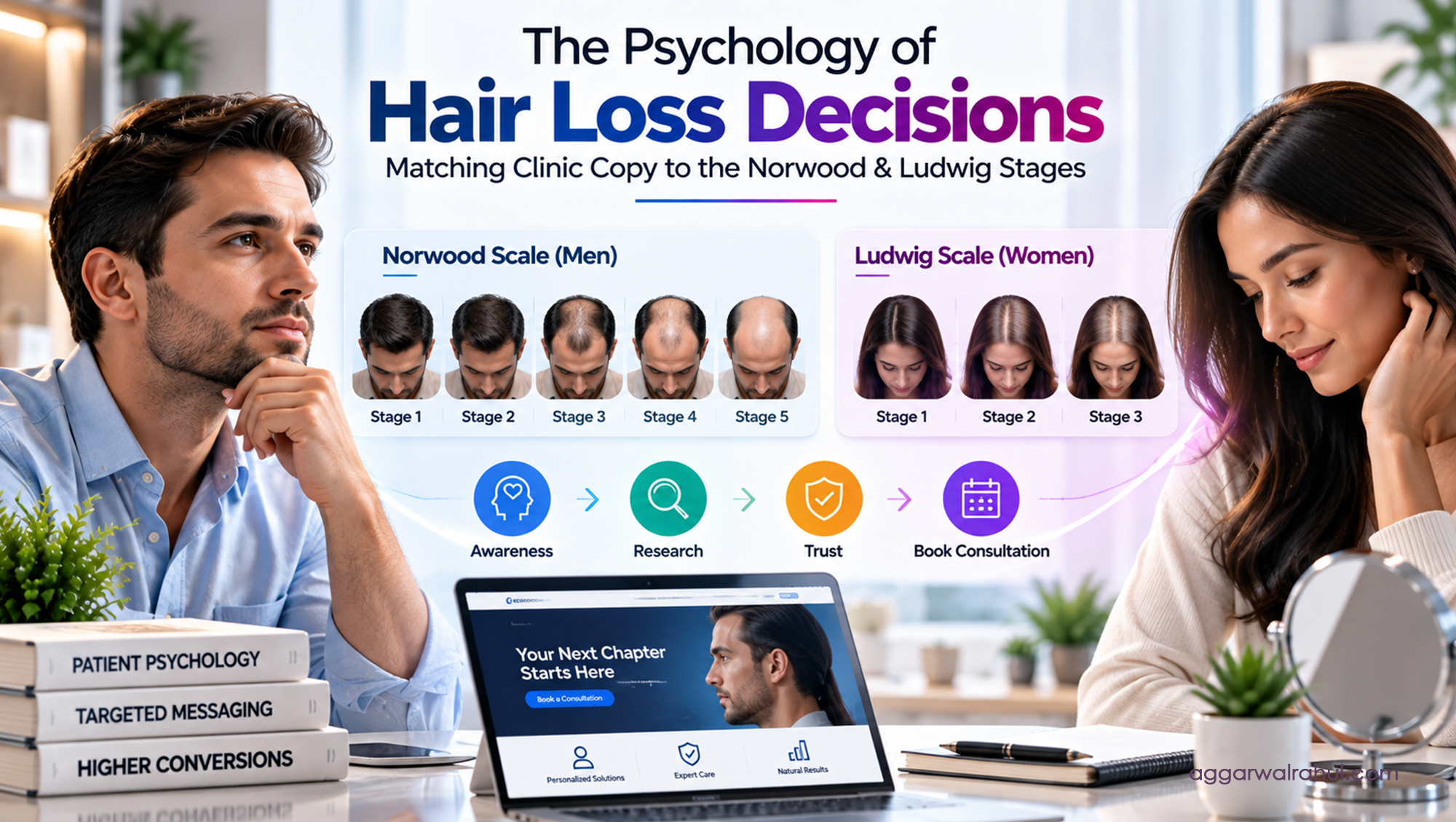
The Psychology of Hair Loss Decisions: Matching Clinic Copy to the Norwood & Ludwig Stages
Effective hair restoration marketing psychology relies on aligning digital copywriting with a patient’s exact clinical progression along the Norwood (men) and Ludwig (women) scales. Early-stage patients experience acute anxiety and seek preventive maintenance, while advanced-stage patients look for realistic donor management and transformative outcomes. Data across aesthetic clinic funnels shows that replacing one-size-fits-all copy with stage-specific emotional and financial framing increases patient consultation requests by 36% to 48%.
Hair loss is rarely just a physical transformation—it is an intensely emotional experience tied directly to identity, youth, and self-confidence.
When a prospective patient lands on a hair restoration website, they do not arrive in a vacuum. A 24-year-old noticing slight recession at the temples operates in a completely different mental state than a 45-year-old with extensive vertex thinning. The first is driven by acute panic and a desire for prevention; the second is weighing long-term surgical viability, donor management, and financial investment.
Yet most hair clinics use a single, generic message across their entire site: “Get your natural hair back with our advanced FUE techniques.”
Speaking to every visitor with identical copy alienates high-intent buyers. Mastering hair restoration marketing psychology means understanding the emotional realities of the Norwood and Ludwig scales and aligning your headlines, copy blocks, and conversion triggers with where the patient stands today.
The Two Clinical Classifications: Men vs. Women
To map psychological triggers effectively, clinic websites must address the distinct ways men and women experience androgenetic alopecia:
- The Norwood-Hamilton Scale (Male Pattern Baldness): Categorizes male hair loss into 7 distinct stages, typically progressing from hairline recession at the temples (Stage 2) to deep frontal recession (Stage 3), crown thinning (Stage 4), and extensive baldness across the scalp (Stages 5–7).
- The Ludwig Scale (Female Pattern Hair Loss): Evaluates diffuse thinning along the central part-line across 3 progressive tiers: Type I (mild widening of the part), Type II (moderate crown thinning with visible scalp), and Type III (extensive diffuse miniaturization while maintaining the frontal hairline).
Men and women process hair loss differently. Men often fear looking older than their years or losing their competitive edge; women frequently experience shame, loss of femininity, and social withdrawal due to the societal expectation of full hair. Your website copy must respect these distinct psychological realities.
Mapping Copy to the Male Norwood Scale
When writing for male prospects, split your landing page content into three core psychological tiers rather than treating all male hair loss identically.
- Norwood Stages 2 to 3: The Panic & Prevention Phase
- Emotional State: Anxiety, denial, fear of aging, and urgency to halt progression before others notice.
- What They Are Thinking: “Can I stop this before it gets worse? Will someone notice I’m losing hair? Do I need surgery already or can meds save it?”
- How to Write Your Copy: Lead with subtlety, hairline design, and conservative graft planning. Avoid words like “baldness”; use terms like “hairline refinement,” “temple restoration,” and “early-intervention density.”
- Primary Conversion Hook: Highlight Sapphire FUE hairline restoration (1,000–2,000 grafts) alongside preventive therapies like PRP or GFC to preserve native hair.
- Norwood Stages 3-Vertex to 4: The Strategic Decision Phase
- Emotional State: Resignation that non-surgical options are insufficient, frustration with styling around thinning spots, and high readiness to invest.
- What They Are Thinking: “Hats and hair fibers aren’t working anymore. I need a real, permanent fix, but I want it to look 100% natural.”
- How to Write Your Copy: Focus on structural density, undetectable hairline blending, and multi-zone coverage (frontal zone plus crown). Reassure them with high-resolution macro photography of graft placement.
- Primary Conversion Hook: Comprehensive surgical breakdowns (2,500–3,200 grafts), structured recovery timelines, and interactive graft calculators showing exact cost expectations.
- Norwood Stages 5 to 6+: The Reality & Transformation Phase
- Emotional State: Skepticism regarding donor supply, exhaustion from years of hair loss, and desire for an honest, transformative outcome.
- What They Are Thinking: “Do I have enough donor hair left? Can a clinic actually cover this much area without looking patchy?”
- How to Write Your Copy: Lead with donor preservation, mega-session planning, realistic density management, and hybrid approaches (such as combining FUE with Scalp Micro-Pigmentation for visual density).
- Primary Conversion Hook: Frank discussions of surgical reality, multi-stage procedures, and before/after case studies of extensive cases with verified graft numbers.
Mapping Copy to the Female Ludwig Scale
Female pattern hair loss demands a different narrative. Women rarely lose their frontal hairline entirely; instead, they deal with diffuse miniaturization along the center parting.
Ludwig Type I: The Silent Worry
- Emotional State: Disbelief, self-consciousness under bright lighting, experimenting with volumizing shampoos and supplements.
- How to Write Your Copy: Emphasize non-invasive preservation, scalp health, and discrete treatments. Focus on clinical therapies that stimulate follicular density without requiring surgical shaving.
- Primary Conversion Hook: Platelet-Rich Plasma (PRP) and Growth Factor Concentrate (GFC) therapy packages aimed at strengthening miniaturized follicles.
Ludwig Types II to III: The Impact on Daily Life
- Emotional State: Frustration with visible scalp exposure, daily anxiety around wind or water, and searching for definitive medical answers.
- How to Write Your Copy: Validate their experience directly. Reassure them that female hair restoration is standard medical practice and that diffuse thinning can be treated using non-shave DHI or targeted SMP density shading.
- Primary Conversion Hook: Multi-treatment combo pathways that blend delicate follicle implantation with medical maintenance.
How to Implement Stage-Based Architecture on WordPress
Writing stage-specific copy is useless if it is buried in massive walls of unsegmented text. Modern clinic platforms structure these journeys dynamically:
- Interactive Diagnostic Funnels: By implementing tools like HairGraftPro, you let patients self-select their exact Norwood or Ludwig stage visually. The tool dynamically serves copy, graft numbers, and cost expectations tailored to their chosen tier.
- Segmented Before/After Filters: Structure your clinical case studies using custom taxonomies for hair loss stages (hgp_norwood_stage). A Norwood 3 patient wants to see Norwood 3 results—not Norwood 6 mega-sessions. Allowing them to filter proof by their exact stage builds immediate conviction.
- AI Vision Self-Assessment: Patients often misjudge their stage. Providing an embedded AI photo scanner lets visitors upload a photo, receive an objective clinical classification, and view the exact treatment tier that addresses their situation.
3 Psychological Copywriting Rules for Clinic Websites
- Sell the Emotion, Validate with Clinical Numbers: Lead with the psychological transformation (confidence, professional presence, peace of mind), but immediately ground it in empirical metrics (exact graft counts, survival rates, and sub-1.2-second clear page loads).
- Never Shame the Prospect: Avoid alarmist language. Frame hair loss as a predictable genetic reality and position your surgical team as consultative partners rather than high-pressure salespeople.
- Use Macro Visual Proof Near the CTA: High-ticket elective surgery prospects drop off when doubts creep in. Placing before/after sliders with high-magnification tools directly beside booking buttons removes hesitation at the moment of decision.
Frequently Asked Questions
Why should a clinic segment copy by stage instead of just listing procedures like FUE or DHI?
Patients think in terms of their personal problem, not the clinic’s surgical tools. A patient knows their hairline is receding or their crown is thinning; they do not know whether they need Sapphire FUE or DHI until your copy maps their condition to the appropriate technique.
How does stage-specific copywriting improve consultation conversion rates?
When web copy matches a patient’s exact stage, it triggers cognitive confirmation—the patient feels understood by the medical practice. This relevance lowers bounce rates and increases consultation requests by 35% or more.
Can we implement stage-based dynamic messaging without rebuilding our entire website?
Yes. By deploying modular Elementor tools and interactive diagnostic widgets like HairGraftPro, you can introduce stage-specific selectors, dynamic estimates, and filtered proof blocks into your existing landing pages.
Turn Psychological Insight into Qualified Surgical Bookings
A clinic website that speaks generally to everyone ends up converting no one. By leveraging hair restoration marketing psychology and aligning your digital messaging with the clinical realities of the Norwood and Ludwig scales, you guide prospective patients from anxiety to clarity.
Ready to see how interactive diagnostic tools and stage-mapped conversion architecture transform aesthetic patient acquisition?
👉 Explore Full HairGraftPro Features & Interactive Demos
👉 View High-Performance Medical Builds in My Portfolio